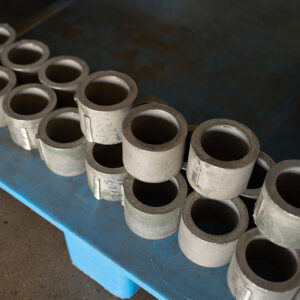
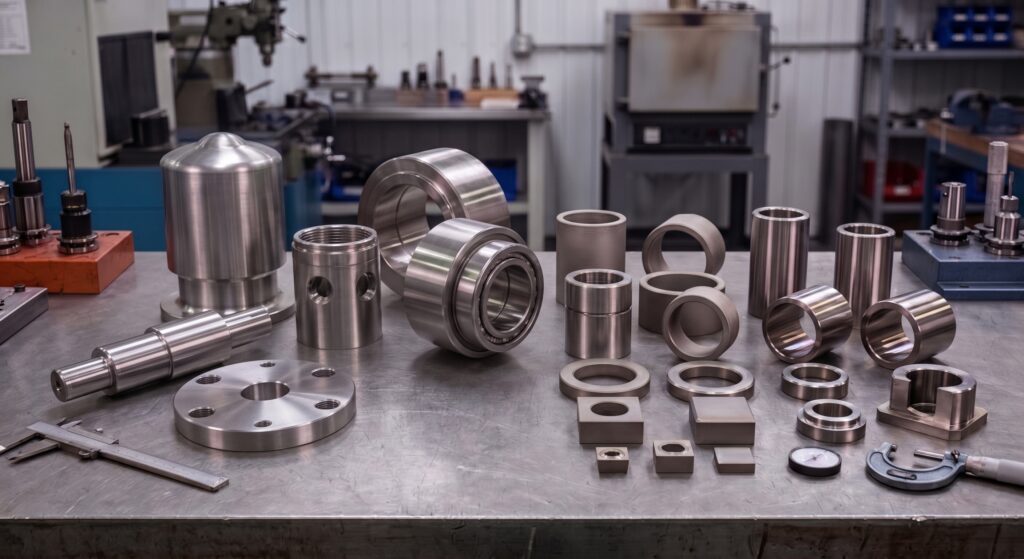
SYTOP supplies both cast cobalt alloy parts and powder metallurgy cobalt alloy parts from customer drawings. Casting forms the part by pouring molten alloy into a mold and allowing it to solidify. Powder metallurgy forms cobalt alloy powder and sinters it into the required shape. Different forming methods will affect the structure of producible parts, mold design and costs, machining allowances, material properties, etc.
Neither process is automatically better. Casting is often practical for irregular three-dimensional shapes, changing section thicknesses, and larger custom components. Powder metallurgy is often considered for repeat parts whose geometry can be formed with stable density and controlled shrinkage. In both cases, critical fits, sealing surfaces, and tight tolerances may still require machining or grinding.
How Are Cast Cobalt Alloy Parts Produced?
Cobalt-based alloy products are typically manufactured using the silica sol precision casting process, which involves mold design and fabrication, wax pattern making, shell building, casting, and sand removal. The products will undergo machining and inspection in accordance with drawing specifications after heat treatment.
How Are Powder Metallurgy Cobalt Alloy Parts Produced?
Powder metallurgy cobalt alloy parts are produced using alloy powder as the raw material. The parts undergo isostatic pressing, die pressing, or injection molding to form the blanks, followed by a sintering process, after which machining is carried out in accordance with the finished-part drawings.
SYTOP utilizes powder metallurgy to manufacture components such as saw blade segments, shaft sleeves, bushings, rings, wear-resistant blocks, and inserts—provided their geometries are suitable for powder forming and they require repetitive production.
Casting vs Powder Metallurgy: Which Process Fits Your Cobalt Alloy Part?
| Decision Factor | Casting | Powder Metallurgy |
|---|---|---|
| Suitable geometry | Irregular profiles, three-dimensional features, changing sections, and larger custom shapes. | Repeat geometry that can be formed and consolidated with stable density and predictable shrinkage. |
| Production volume | Often varies quantities; tooling depends on the casting method. | Often more attractive for repeat medium-to-high quantities where tooling and process setup can be spread across the order. |
| Tolerance and finish | The casting provides the basic shape; tight dimensions and functional surfaces are commonly machined or ground. | Repeat dimensions can be controlled through tooling and shrinkage management; critical fits may still need machining or grinding. |
| Material structure | A solidification structure; segregation, shrinkage, and casting porosity are controlled through casting design and process control. | A consolidated powder structure; density, residual porosity, and consolidation uniformity are the main controls. |
| Typical components | Valve trim, irregular wear blocks, larger sleeves, rings, and complex inserts. | Repeat bushings, sleeves, rings, blocks, and wear inserts with compatible geometry. |
| Machining and material use | Near-net casting can reduce removal on complex shapes that would waste material if cut from solid stock. | Near-net powder forming can reduce material removal on compact, repeat shapes when the tooling is justified. |
SYTOP compares the alloy grade, part geometry, order quantity, machining requirement, and acceptance criteria before recommending casting or powder metallurgy for a custom cobalt alloy part.
What Are the Common Cobalt Alloy Grades and Standards?
The alloy grade and the production process answer different questions. The grade defines the intended cobalt alloy chemistry and performance range; the process determines how the component is formed. Cobalt Alloy 6 and Cobalt Alloy 12 provide two useful examples of the reference language commonly seen on drawings and material specifications.
| Cobalt Alloy | UNS Reference | Common AWS Reference | Common Product Forms |
|---|---|---|---|
| Cobalt Alloy 6 | UNS R30006 | AWS A5.13 ECoCr-A (covered electrode); AWS A5.21 ERCoCr-A (bare rod or electrode) | Cast parts, powder metallurgy parts, hardfacing consumables, and machined components. |
| Cobalt Alloy 12 | UNS R30012 | AWS A5.13 ECoCr-B (covered electrode); AWS A5.21 ERCoCr-B (bare rod or electrode) | Cast parts, powder metallurgy parts, hardfacing consumables, and custom wear parts. |
SYTOP can provide welding consumables, castings, powder metallurgy parts, or machined components in various cobalt alloy grades.
Where Can I Get Custom Cast or Powder Metallurgy Cobalt Alloy Parts?
SYTOP manufactures custom cast cobalt alloy parts and powder metallurgy cobalt alloy parts from customer drawings. Components can be supplied as blanks, semi-finished parts, or fully machined products, with material certification and dimensional inspection records. Additional testing or third-party inspection can be included when it is defined before the order is released.
To evaluate your component, send:
- The current drawing and revision number
- The cobalt alloy grade, material specification, or required chemistry
- Quantity per order and expected repeat demand
- Required delivery condition: blank, semi-finished, or finished part
- Critical dimensions, tolerances, and inspection requirements
You do not need a complete RFQ package to begin. Send the drawing and the information already available, and SYTOP can review whether casting or powder metallurgy is the more practical manufacturing option before preparing the quotation.
WhatsApp / WeChat: +86 130 0924 9727
Email: marketing@sytop.cn