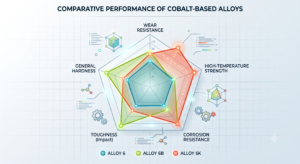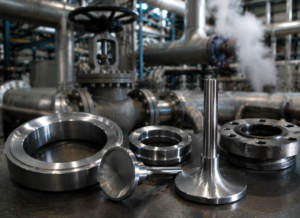
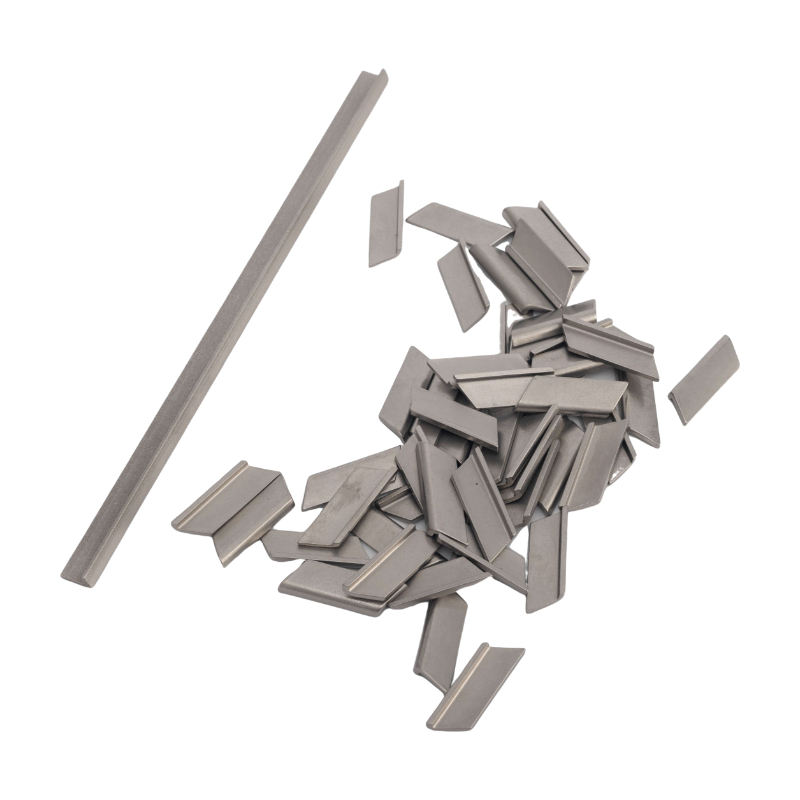
If you are comparing Cobalt Alloy 6 and Cobalt Alloy 6B for steam turbine blade protection strips, the main difference is not simply which alloy is harder or better. Both belong to the cobalt-chromium-tungsten alloy family, but they are supplied in different material conditions and product forms.
For turbine blade erosion shields, the appropriate choice depends on the material specified by the existing design, the required strip geometry, the applicable material standard, and the wet-steam operating environment.
Cobalt Alloy 6 and Cobalt Alloy 6B
Cobalt Alloy 6 and Cobalt Alloy 6B are cobalt-chromium-tungsten-carbon alloys developed for applications requiring resistance to wear, erosion, and corrosion.
In low-pressure steam turbine stages, blade leading edges can be exposed to repeated impact from high temperature and high velocity water droplets. Wet steam and condensate may also introduce corrosion-related damage depending on factors such as pH, dissolved oxygen, chlorides, and sulfates.
Cobalt alloy protection strips are used to protect these vulnerable blade areas and help reduce loss of the original leading-edge profile.
Although Cobalt Alloy 6 and 6B share a similar alloy basis, their material condition and available product forms are different.
Cobalt Alloy 6 vs. Cobalt Alloy 6B
Cobalt Alloy 6 can be supplied in several product forms and through different manufacturing routes, including cast, powder-based, deposited, and finished components.
Cobalt Alloy 6B is a wrought cobalt alloy typically supplied as sheet, plate, and bar.
This difference is particularly relevant for steam turbine blade strips because the finished component may require a continuous thin section, controlled curvature, and a defined profile that follows the turbine blade geometry, sometimes even necessitating bending or deformation during welding.
Where an existing design specifies Cobalt Alloy 6, the required product form and applicable material specification should be confirmed from the drawing and purchasing documents.
Where the drawing specifies Cobalt Alloy 6B, wrought sheet or plate provides a clearly defined material basis for manufacturing curved protection strips.
UNS R30006 and UNS R30016
UNS designations are commonly used to identify cobalt alloy grades.
UNS R30006 is commonly associated with Cobalt Alloy 6, while UNS R30016 identifies Cobalt Alloy 6B.
However, a UNS number identifies the alloy rather than defining the complete supply requirement. Product form, material condition, testing, and acceptance requirements should still be confirmed through the applicable material specification and order documents.
This is especially important when sourcing replacement turbine components from older drawings that may contain only a shortened alloy description.
What AMS 5894 Means for Cobalt Alloy 6B
Cobalt Alloy 6B is commonly referenced as UNS R30016, and SAE AMS 5894 covers the alloy in solution-heat-treated bar, sheet, and plate.
For turbine blade protection strips manufactured from wrought sheet or plate, AMS 5894 provides a documented material basis for the starting material.
The standard does not, however, define the complete finished erosion shield.
The customer drawing continues to define requirements such as:
- Curvature
- Thickness
- Strip length
- Leading-edge profile
- Edge geometry
- Surface condition
- Dimensional tolerances
- Part identification
This distinction is important because the material specification defines the cobalt alloy product, while the drawing defines the finished turbine blade strip.
Which Is Better for Steam Turbine Blade Protection Strips?
There is no universal answer that Cobalt Alloy 6B is always better than Cobalt Alloy 6, or vice versa.
Both materials can be used for steam turbine blade protection strips when they match the established component design and material requirements.
Cobalt Alloy 6B is particularly relevant when the design requires a wrought sheet- or plate-based material for a continuous thin or curved strip.
Cobalt Alloy 6 remains relevant where an existing turbine design specifies a defined Cobalt Alloy 6 product form.
The correct selection should therefore begin with the existing drawing and material specification rather than hardness alone.
Cobalt Alloy 6 and 6B Steam Turbine Blade Strips from SYTOP
Whether your project requires Cobalt Alloy 6 or Cobalt Alloy 6B, SYTOP can manufacture finished steam turbine blade protection strips according to customer drawings.
We can support different strip dimensions, curvatures, profiles, and material requirements for OEM and replacement components.
Material certificates and dimensional inspection reports can be supplied with the finished parts. When required, additional inspection such as hardness testing, chemical composition verification, non-destructive testing, or third-party inspection can also be arranged according to the agreed project requirements.
If your existing drawing contains only a shortened cobalt alloy designation, you can send us the drawing together with the available material reference, previous certificate, and inspection requirements for review.
Send your steam turbine blade strip drawings to SYTOP via WhatsApp / WeChat: +86 130 0924 9727 or inquiry@sytop.cn for material and manufacturing evaluation.