Cobalt Alloy 6, 6B, and 6K are often discussed together, but the grade name alone is not enough to explain their differences. Although they belong to the same cobalt-chromium-tungsten alloy family, their carbon content, production process, product form, and performance characteristics create different application advantages.
The correct choice depends not only on wear resistance, but also on whether the component requires toughness, hardness, edge retention, machinability, or a specific manufacturing condition.
Cobalt Alloy 6 vs 6B vs 6K at a Glance
Cobalt Alloy 6, 6B, and 6K belong to the cobalt-chromium-tungsten alloy family.
Cobalt Alloy 6 is the most widely used grade and can be produced through casting or powder metallurgy processes. Cobalt Alloy 6B is a wrought alloy, while Cobalt Alloy 6K is a higher-carbon rolled alloy designed for applications where hardness and edge retention are more important.
| Difference | Cobalt Alloy 6 | Cobalt Alloy 6B | Cobalt Alloy 6K |
|---|---|---|---|
| Typical carbon | About 0.90-1.40% | Nominal 1.15% in AMS 5894 | Commonly about 1.40-1.90% |
| Material condition | Multiple forms and processes | Defined wrought alloy | Higher-carbon wrought/rolled alloy |
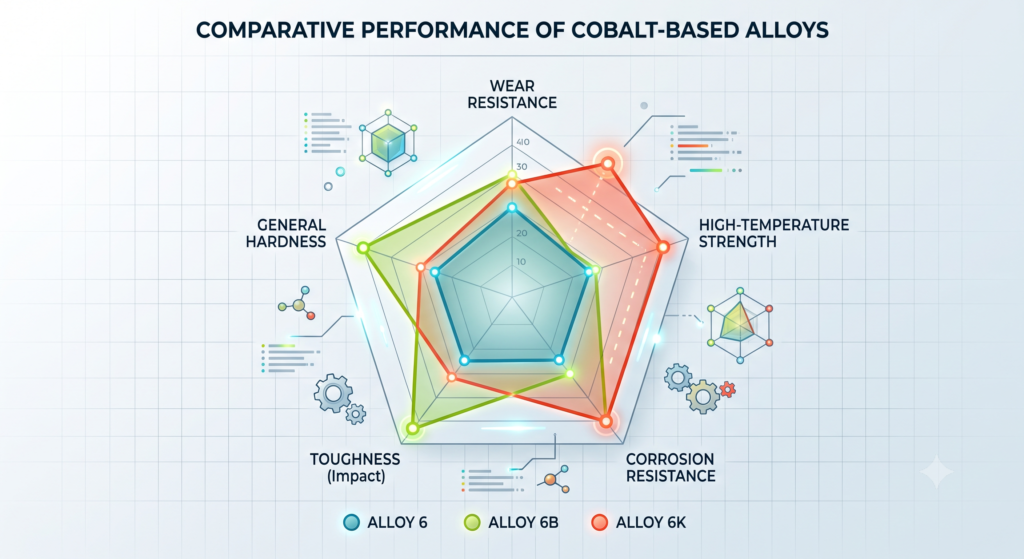
| Performance emphasis | Balanced general wear | Wear resistance with greater toughness margin | Higher hardness and edge retention |
| Common forms | Cast/PM parts, hardfacing, blanks, finished parts | Bar, sheet, plate, machined parts | Rolled sheet/plate, knives, scrapers |
| Reference | UNS R30006; product-specific standard | UNS R30016 / AMS 5894 | Drawing and agreed supplier specification |
Carbon, Carbides, Hardness, and Toughness
Carbon content plays an important role in cobalt alloy performance because it influences carbide formation.
Cobalt Alloy 6 and 6B are commonly reported around 0.90-1.40% carbon. AMS 5894 specifies wrought 6B with a nominal carbon content of 1.15%.
Cobalt Alloy 6K generally contains a higher carbon range of approximately 1.40-1.90%, with published nominal data near 1.6%.
The higher carbon content of 6K increases carbide-forming potential, shifting the material toward higher hardness and stronger edge retention. However, the tradeoff is reduced ductility and a narrower forming and machining margin.
This makes Cobalt Alloy 6K suitable for cutting and scraping applications where edge retention is important, but it does not mean 6K is a universal replacement for 6 or 6B.
Production Process and Product Form
Cobalt Alloy 6
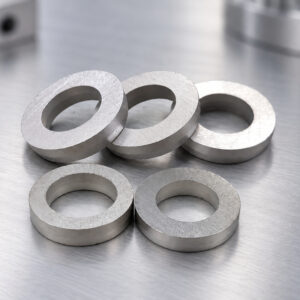
Cobalt Alloy 6 can be supplied through different manufacturing routes, including casting and powder metallurgy. Depending on the specification, it can be used for hardfacing materials, blanks, finished wear components, and custom parts.
Its balanced combination of wear resistance and toughness makes it one of the most widely used cobalt alloy grades.
Cobalt Alloy 6B
Cobalt Alloy 6B is a wrought alloy commonly supplied as bar, sheet, and plate.
It is frequently considered for applications requiring a wrought product condition, including:
- Machined bushings
- Sleeves
- Wear plates
- Turbine blade shields
- Custom machined components
The main difference from Cobalt Alloy 6 is not simply quality. The difference is the defined wrought composition and product form.
Cobalt Alloy 6K
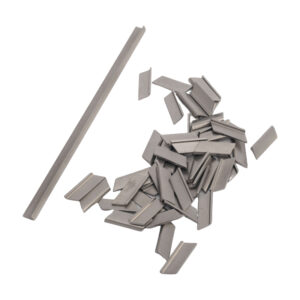
Cobalt Alloy 6K is also associated with wrought and rolled sheet or plate products. Its higher carbon content gives it increased carbide formation potential and improved edge retention.
Because of this balance, it is more commonly considered for:
- Knives
- Scraper blades
- Cutting components
- Wear parts requiring higher hardness
However, the higher hardness also means a narrower processing window compared with tougher grades.
UNS and AMS References
Material references help identify alloy requirements, but the final selection should always consider the drawing, product form, and application requirements.
- Cobalt Alloy 6: Commonly associated with UNS R30006. AMS 5387 may apply to certain investment castings when the composition and scope match the drawing requirements.
- Cobalt Alloy 6B: Commonly identified as UNS R30016. SAE AMS 5894 covers solution heat-treated bar, sheet, and plate products.
- Cobalt Alloy 6K: Does not have the same widely used UNS/AMS combination and should be confirmed according to drawing and supplier specification.
Common Misunderstandings About 6, 6B, and 6K
6B is not simply a higher-quality version of 6
Cobalt Alloy 6B is not an upgraded version of Cobalt Alloy 6. Its main distinction is the defined wrought alloy composition and product form.
6K is not the best choice for every wear application
The higher carbon content of 6K provides advantages in hardness and edge retention, but not every component benefits from this balance.
6B and 6K are not interchangeable
Although both may be supplied as wrought products, their performance balance and intended applications are different.
Grade name alone is not enough
A cobalt alloy grade should always be considered together with:
- Product form
- Manufacturing process
- Drawing requirements
- Inspection standard
- Service condition
How to Choose Between Cobalt Alloy 6, 6B, and 6K
A practical selection approach is:
- Choose Cobalt Alloy 6 when balanced wear resistance and toughness are required across a wide range of applications.
- Choose Cobalt Alloy 6B when a wrought alloy form such as bar, sheet, or plate is required with a stronger toughness margin.
- Choose Cobalt Alloy 6K when higher hardness and edge retention are more important, especially for knives and scraping applications.
The best grade depends on the finished component rather than the alloy name alone.
Need Help Selecting the Right Cobalt Alloy Grade?
For a component-specific comparison, send the finished drawing, material reference, product form, quantity, and required documents to SYTOP.
We can help evaluate whether Cobalt Alloy 6, 6B, or 6K is more suitable for your application.
Contact WhatsApp / WeChat: +86 130 0924 9727
Email: marketing@sytop.cn
FAQ
What is the main difference between Cobalt Alloy 6 and 6B?
Cobalt Alloy 6 is available through several manufacturing processes and product forms. Cobalt Alloy 6B is a defined wrought alloy commonly supplied as bar, sheet, and plate under UNS R30016 / AMS 5894.
What does the higher carbon content of Cobalt Alloy 6K change?
Higher carbon increases carbide-forming potential, improving hardness and edge retention while reducing ductility and processing margin.
Can Cobalt Alloy 6K replace Cobalt Alloy 6B?
Only when the component benefits from the 6K hardness and edge-retention balance and when the drawing, product form, and acceptance requirements support the change. It is not a general replacement for 6B bushings, sleeves, wear plates, or turbine blade shields.